Call Us Today: 862-283-3155
Ensuring that your child is getting a proper education is difficult, but it can be even more onerous when you are the parent of a child who has special needs. Often, these students require additional or special programs to help facilitate their learning. For example, a student may need additional time to complete tests, or a much more substantial adjustment, such as a different placement. When determining what additional or special programs a child needs, parents and the school collaborate to create an Individualized Education Plan (IEP) that is designed to appropriately address the student’s unique circumstances.
Unfortunately, the school may propose an IEP that you do not agree with or that you want to alter. As a result, there are several dispute resolution options available to address your concerns, and a New Jersey education lawyer can help you navigate this process.
Children with disabilities are entitled to equal access to an education, in accordance with the Individuals with Disabilities Education Act (IDEA). Because the IDEA recognizes the potential for disagreement regarding a student’s program, the law provides parents with the ability to challenge the school’s decisions. Specifically, these provisions make up the dispute resolution process, and they afford Parents the right to have meaningful input into their students’ education.
Under the IDEA, parents have the option of trying to resolve disputes at mediation before requesting a due process hearing. In a mediation session, a mediator acts as a neutral third party who attempts to facilitate a resolution between the parent(s) and the school. The mediator’s role is not to render a decision, but to work with the two sides to find areas of agreement. If an agreement is reached during the mediation, the parties will memorialize the settlement in writing, which makes the agreement binding on the parents and the school.
The parents also have the right to request a due process hearing. To initiate due process, a parent must file a complaint (which includes the name of the parties, a description of the dispute, and the relief that is sought) with the Office of Special Education Programs (OSEP).
If the matter does not settle, a hearing will be scheduled. This proceeding mimics a trial in that both sides present their cases through evidence and witnesses. Considering the procedures involved in a due process hearing, it is recommended that you hire a lawyer to represent you.
Determining the best way to provide a student with an appropriate education can be stressful. Thankfully, in many cases, the school is accommodating and helpful. However, there are times when the parents and the school may differ on what is best for the student.
The most common areas of conflict include:
Despite the potential for conflict, you should never feel guilty about advocating for the rights of your student.
If you have a disagreement with your child’s school regarding the creation or implementation of an IEP, our New Jersey education lawyers at John Rue & Associates, LLC will help you determine the best course of action. We provide parents with a preliminary consultation with a New Jersey special education lawyer for $100 (30 minutes by phone). After the preliminary consultation, a more detailed discussion (with two lawyers for 90 minutes to three hours by Zoom) costs a flat fee of $795. Call us at 862-283-3155 or contact us online for more information. Located in Montclair, New Jersey, we serve clients throughout the state.
Rue Law Group, LLC
Princeton Office
100 Overlook Center, 2nd Floor #9211
Princeton, NJ 08540
862-283-3155 (Phone)
973-860-0869 (Fax)


John D. Rue is responsible for the content of this website. This website is designed for general information only. The information presented at this site should not be construed to be formal legal advice nor the formation of a lawyer/client relationship
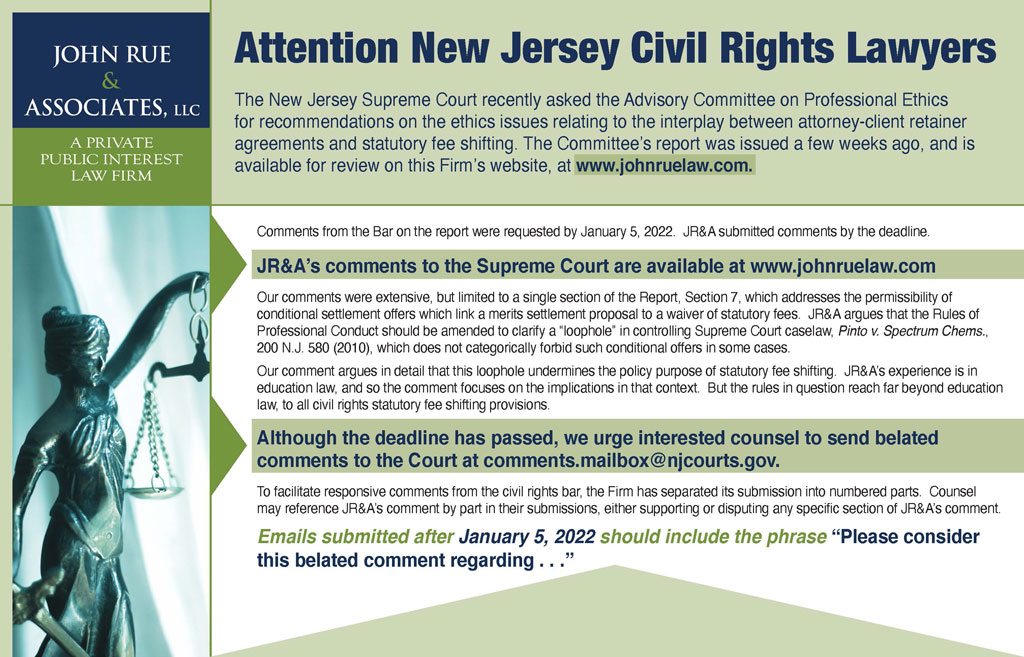
Attention NJ Civil Rights Lawyers
LEARN MORE »